

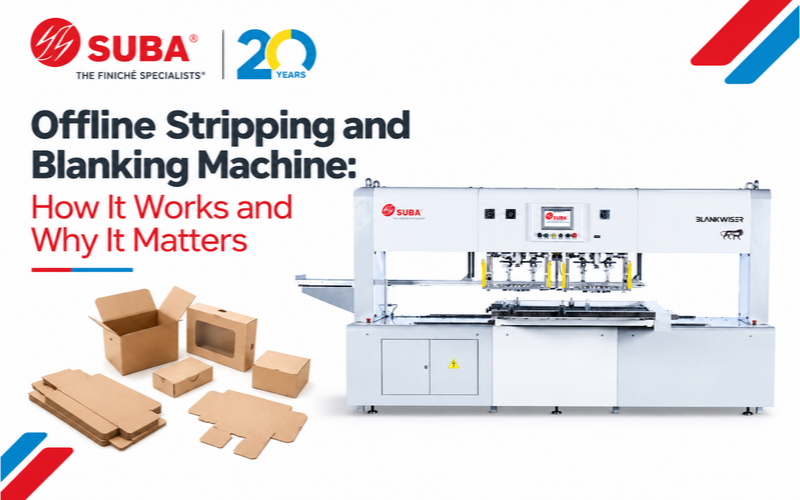
Offline Stripping and Blanking Machine: How It Works and Why It Matters
Die cutting creates the required carton shape, but the process often continues with stripping and blanking before the cartons can move to the next production stage. When these operations are handled manually, complex layouts, multi-up jobs and high production volumes can increase operator workload and handling time.
An offline stripping and blanking machine automates this post-die-cutting stage by separating waste from finished carton blanks and organizing the blanks for further processing. Suba Solutions’ Blankwiser is designed for folding carton applications where manufacturers need more controlled stripping, blanking and waste handling.
What Is an Offline Stripping and Blanking Machine?
An offline stripping and blanking machine processes die-cut sheets separately from the die-cutting machine.
Stripping involves separating unwanted waste material from the die-cut sheet, while blanking separates the finished carton blanks into a controlled output. Instead of depending entirely on manual hammering, stripping and sorting, an automated system uses positioning, blanking heads and waste-removal mechanisms to handle these operations.
Because the machine works offline, stripping and blanking can be moved into a separate production stage after die cutting. This can help reduce downstream handling constraints around the die-cutting process.
How Does an Offline Stripping and Blanking Machine Work?
The exact sequence varies by configuration, but the basic process includes:
1. Die-Cut Sheet Loading
Completed die-cut sheets are loaded onto the machine’s carrier or loading system. The sheets contain the finished carton shapes as well as surrounding waste material.
2. Sheet Positioning
The sheet is positioned for the blanking operation. Servo-driven positioning systems help place the sheet correctly before the blanking heads operate.
3. Waste Stripping
The surrounding waste is separated from the finished carton blanks. Waste-removal systems can then guide unwanted material away from the working area.
4. Blanking
Blanking heads separate the individual finished carton blanks from the sheet. Depending on the configuration, multiple blanking heads can be used for different production requirements.
5. Window-Hole and Waste Removal
Selected configurations can include a dedicated window-hole remover and waste-removal slopes for additional waste handling.
6. Finished Blank Handling
After separation, the finished blanks are handled in a controlled sequence so they can move to subsequent processes such as folding and gluing.
This offline approach can be particularly useful for manufacturers processing complex carton shapes or multi-up layouts.
Key Features of Blankwiser
Suba’s Blankwiser range includes features designed to improve positioning, blank separation and operator handling.
| Feature | Production relevance |
|---|---|
| Servo-driven positioning | Supports controlled sheet positioning |
| Double-head blanking | Enables efficient blank separation |
| Optional third head | Supports window-hole removal on applicable configurations |
| Waste-removal slopes | Helps direct separated waste |
| Safety sensors | Supports safer machine operation |
| Touch-screen control | Provides centralized machine operation |
| Programmable job memory | Helps manage repeat jobs on selected models |
| Battery-operated hydraulic pile lifter | Reduces manual pile-handling effort |
Selected Blankwiser configurations are published with positioning accuracy of up to 10 microns. Exact features and specifications vary by model.
Benefits of Offline Stripping and Blanking
Reduced Manual Stripping
Automation reduces the need for repetitive manual stripping, hammering and sorting of die-cut sheets.
More Consistent Blanking
Controlled positioning and blanking systems can provide more repeatable separation of finished carton blanks.
Lower Operator Workload
Automating repetitive post-die-cutting operations can reduce physical handling and operator fatigue.
Better Die-Cutting Workflow
Moving stripping and blanking offline can help reduce downstream stripping constraints around the die-cutting operation.
Suitable for Complex Jobs
Blankwiser is positioned for complex shapes, multi-up layouts and different die-cut carton applications.
Controlled Waste Handling
Waste slopes and optional window-hole removal systems can help manage waste after the blanking operation.
Applications of Offline Stripping and Blanking Machines
Offline stripping and blanking is particularly relevant to folding carton production and other die-cut paperboard applications.
Typical applications include:
- Folding cartons
- Complex carton shapes
- Multi-up carton layouts
- Ice-cream lids
- Tags
- Matchboxes
- Other die-cut paperboard products
- Cartons with window holes
The appropriate configuration depends on the sheet format, blank design, number of ups, waste pattern and production requirement.
Hygiene and Surface Protection
Suba’s Blankwiser information highlights a pile-loaded carrier concept designed to reduce direct bottom-surface contact with the table. This can help reduce the risk of scratches or unwanted surface contact during handling.
This feature can be relevant for packaging applications where finished-sheet appearance and surface condition are important. Actual handling and hygiene practices should always follow the requirements of the production environment.
Blankwiser Model Options
Suba Solutions lists different Blankwiser configurations, including:
- BW 106
- BW 106 E
- BW 96
- BW PT XL
The configurations can differ in carrier size, hydraulic arrangement, waste handling, robotic pick-up and window-hole removal capabilities.
Therefore, the correct model should be selected according to the actual sheet format, carton layout, blank size and production requirement rather than simply choosing the largest available configuration.
What to Consider Before Buying?
Before selecting an offline stripping and blanking machine, evaluate:
- Die-cut sheet size
- Finished blank size
- Carton layout
- Number of ups
- Blank shape and complexity
- Window-hole requirements
- Monthly or hourly production volume
- Current manual stripping workload
- Die-cutter model and output
- Folder-gluer requirements
- Available floor space
- Material-handling requirements
It is also useful to provide actual die-cut samples or carton layouts when discussing machine selection. This allows the machine configuration to be evaluated against the real production application.
Suba Solutions Blankwiser
Suba Solutions positions Blankwiser as an automated offline stripping and blanking solution for folding carton and die-cut packaging applications.
The machine range is designed to address manual stripping bottlenecks through controlled positioning, blanking and waste handling. Depending on the configuration, options can include multiple blanking heads, window-hole removal, waste-removal systems, job memory, safety sensors and automated pile handling.
For manufacturers considering automation, the important point is not simply machine speed. The right configuration should match the die-cut sheet, carton layout, number of ups, blank complexity and required production output.
Frequently Asked Questions
1. What is the difference between stripping and blanking?
Stripping separates unwanted waste from a die-cut sheet, while blanking separates the finished carton blanks into a controlled output.
2. Does an offline blanking machine replace a die cutter?
No. An offline stripping and blanking machine works after the die-cutting process and handles the separation of waste and finished blanks.
3. Can Blankwiser handle complex carton shapes?
Yes, Suba positions Blankwiser for both simple and complex die-cut jobs, including multi-up carton layouts.
4. Can an offline blanking machine remove window holes?
Selected Blankwiser configurations include a dedicated window-hole removal option.
5. Can offline blanking work with a folder gluer?
Yes. The separated carton blanks can move to subsequent processes such as folding and gluing, subject to the product and production setup.
Conclusion
For folding carton manufacturers, offline stripping and blanking can turn a labour-intensive post-die-cutting operation into a more controlled production stage. By automating positioning, blank separation and waste handling, the process can reduce manual intervention while supporting more consistent handling of die-cut cartons.
The right offline stripping and blanking machine should be selected according to sheet size, carton layout, number of ups, blank complexity, window-hole requirements and production volume.
Looking for an Offline Stripping and Blanking Machine?
Share your die-cut sheet size, carton layout, number of ups, blank dimensions, window-hole requirements and monthly production volume with Suba Solutions. If available, provide a die-cut sample or carton drawing so the appropriate Blankwiser configuration can be evaluated for your application.
About Suba Solutions
Suba Solutions Private Limited provides packaging machinery and related solutions for folding carton, flexible packaging, printing and corrugated box industries. Its portfolio includes offline stripping and blanking machines along with die-cutting, laminating, window patching, folding-gluing and other packaging machinery.