

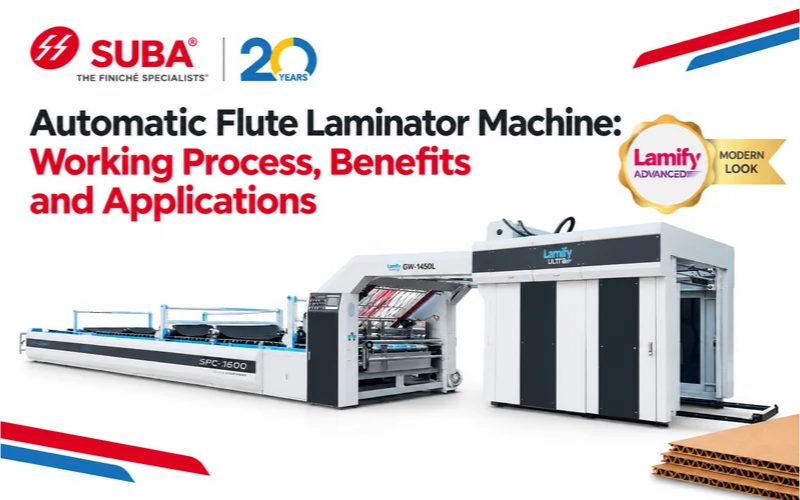
Automatic Flute Laminator Machine: Working Process, Benefits and Applications
An automatic flute laminator machine combines a printed or paperboard sheet with corrugated board using adhesive to create a laminated packaging structure. For manufacturers handling high-volume corrugated and printed packaging, automation helps improve sheet feeding, alignment, bonding consistency and production flow.
Suba Solutions offers automatic flute laminating machines in 3-ply and 5-ply configurations, designed for different board structures and production requirements.
What Is an Automatic Flute Laminator Machine?
A flute laminator feeds, aligns and joins a printed top sheet with corrugated or board material using adhesive. The machine controls the feeding, registration, lamination and pressing process before delivering the finished laminated board for further converting.
The right configuration depends on sheet size, GSM, board thickness, flute type, production output and required board structure.
How Does an Automatic Flute Laminator Work?
The basic flute laminating process involves the following stages:
1. Sheet Feeding
The corrugated board and printed top sheet are fed through dedicated feeding systems. Automatic and servo-controlled feeding helps maintain a controlled flow of material.
2. Sheet Registration
The sheets are aligned before lamination. Servo-controlled positioning and registration systems help maintain the required relationship between the printed sheet and board.
3. Adhesive Application
Adhesive is applied according to the machine configuration and material requirements. Controlled glue-roller systems help maintain consistent adhesive distribution.
4. Sheet Joining
The printed sheet is brought into contact with the corrugated or board substrate after adhesive application.
5. Pressing and Conveying
The joined layers pass through a pressing and conveying section that maintains contact between the sheets while the adhesive sets.
6. Delivery
The laminated board is delivered for further handling or downstream packaging processes.
Actual speed and lamination performance depend on the machine configuration, material quality and job conditions.
Key Features of Automatic Flute Laminators
Depending on the selected configuration, flute laminators can include:
- Servo-controlled sheet feeding
- Automatic sheet registration
- Top-sheet pre-stacking or pallet loading
- Servo tracking for front-guide positioning
- Adjustable glue-roller systems
- Circulating glue systems
- Pressing and extended conveying sections
- Multi-feeder arrangements for 5-ply applications
These features help reduce repetitive manual handling while maintaining controlled material movement during production.
Automatic 3-Ply Flute Laminator
A 3-ply flute laminator is suitable for applications where a printed or top sheet is laminated to a corrugated board structure.
Suba’s 3-ply flute laminating range includes high-speed configurations with features such as servo paper feeding, top-sheet pre-stacking or pallet loading, servo tracking and extended conveying.
The appropriate machine should be selected according to:
- Sheet dimensions
- Top-sheet GSM
- Board thickness
- Flute type
- Required production output
- Registration requirements
- Adhesive system
Automatic 5-Ply Flute Laminator
A 5-ply flute laminator machine is designed for multi-layer board structures and applications requiring additional board layers.
Suba’s Lamify 5 PLY range includes configurations such as SFC-1500 and SFC-1700. Published specifications include maximum sheet sizes of 1500 × 1500 mm and 1700 × 1700 mm respectively, with top-sheet ranges of 120–800 GSM and speeds of up to 150 m/min on the listed configurations.
The exact capability varies by model, so machine selection should be based on the required board structure rather than maximum speed alone.
3-Ply vs 5-Ply Flute Laminator
| Requirement | 3-Ply | 5-Ply |
|---|---|---|
| Board structure | 3-ply applications | 5-ply/multi-layer applications |
| Feeding | Model dependent | Multi-feeder configuration |
| Typical requirement | Printed sheet + corrugated board | Multiple board layers + top sheet |
| Selection factors | Size, GSM, flute and output | Structure, thickness, layers and output |
The final selection should always be matched to the actual production requirement.
Benefits of Automatic Flute Lamination
Consistent Sheet Positioning
Automated feeding and registration help maintain more consistent positioning between the printed sheet and substrate.
Reduced Manual Handling
Automatic feeding and pre-stacking options can reduce repetitive operator work.
Controlled Adhesive Application
Adjustable glue systems help manage adhesive distribution according to the material and production process.
Better Production Flow
Automated feeding, registration and conveying can support continuous production in higher-volume operations.
Flexible Board Structures
Different 3-ply and 5-ply configurations allow manufacturers to select equipment according to their required packaging structure.
Applications of Flute Laminating Machines
Automatic flute laminators can be used for:
- Printed corrugated packaging
- Corrugated boxes
- Retail and FMCG packaging
- Food packaging
- Folding carton substrates
- Printed paperboard products
- Multi-layer corrugated packaging
Suitability depends on the board structure, sheet size, material thickness, flute type, adhesive and machine configuration.
Materials and Adhesives
Depending on the selected machine and application, flute laminators can process combinations of:
- Printed paper or top sheets
- Cardboard
- Corrugated board
- Different flute profiles and thicknesses
Applications may use starch-based, synthetic or resin-based adhesives depending on the substrate and bonding requirements. The appropriate adhesive and material combination should be confirmed for the selected machine and job.
Automatic Flute Laminator Machine Specifications
Specifications vary between models. For example, Suba’s published 5-ply configurations include:
| Specification | SFC-1500 | SFC-1700 |
|---|---|---|
| Maximum sheet size | 1500 × 1500 mm | 1700 × 1700 mm |
| Minimum sheet size | 440 × 400 mm | 440 × 430 mm |
| Top-sheet thickness | 120–800 GSM | 120–800 GSM |
| Maximum speed | 150 m/min | 150 m/min |
| Register accuracy | ±1.5 mm | ±1.5 mm |
Always confirm the latest specification for the exact configuration required.
What to Consider Before Buying?
Before selecting an automatic flute laminator machine, evaluate:
- Maximum and minimum sheet size
- Top-sheet GSM
- Board thickness
- Flute type
- 3-ply or 5-ply requirement
- Required production output
- Registration requirements
- Adhesive type
- Feeding and pre-stacking options
- Available floor space
- Power and compressed-air requirements
- Installation, training and after-sales support
Choosing according to your actual production requirements is more important than selecting a machine based only on its maximum speed.
Suba Solutions Flute Laminators
Suba Solutions offers automatic 3-ply and 5-ply flute laminating machines for corrugated and packaging applications. The range includes configurations designed around different sheet sizes, board structures, feeding arrangements and production requirements.
The 5-ply range includes configurations such as the Lamify 5 PLY 1450, SFC-1500 and SFC-1700, while the 3-ply range includes high-speed automatic flute laminating solutions.
Frequently Asked Questions
What is an automatic flute laminator machine?
It is a machine that bonds a printed or paperboard top sheet with corrugated or board material through controlled feeding, registration, adhesive application and pressing.
How does a flute laminator work?
It feeds and aligns the sheets, applies adhesive, joins the layers and conveys the laminated board through a pressing section before delivery.
What is the difference between a 3-ply and 5-ply flute laminator?
A 3-ply machine handles applicable three-layer board structures, while a 5-ply system is designed for multi-layer board combinations.
Can flute laminators process printed sheets?
Yes, flute laminators are designed to laminate printed or top sheets with corrugated or board substrates within the machine’s specified range.
How do I select the right flute laminator?
Consider your sheet size, GSM, board thickness, flute type, board structure, required output, adhesive system and available installation space.
Conclusion
The right automatic flute laminator machine should match your board structure, sheet dimensions, material thickness, flute type and production target. Whether you require a 3-ply or 5-ply configuration, evaluating feeding, registration, adhesive application and pressing capabilities helps ensure the machine is suitable for your production process.
Looking for an Automatic Flute Laminator?
Share your board structure, sheet size, top-sheet GSM, board thickness, flute type and target production output with Suba Solutions. If available, provide a product sample or board specification so the appropriate flute laminator configuration can be evaluated for your application.
About Suba Solutions
Suba Solutions Private Limited provides packaging machinery and related solutions for the folding carton, flexible packaging, printing and corrugated box industries. Its product portfolio includes flute laminators, dry film laminating machines, die cutting and stripping machines, window patching machines, folding-gluing machines and other packaging equipment.