

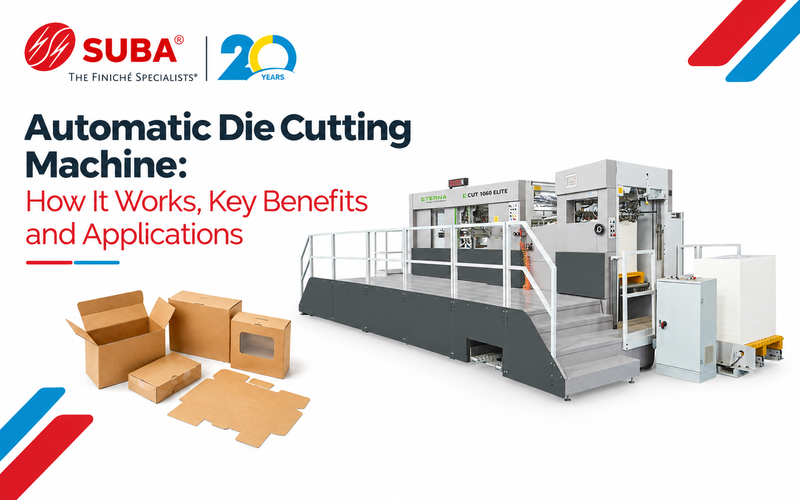
Automatic Die Cutting Machine: How It Works, Key Benefits and Applications
For packaging manufacturers, cutting and creasing are more than just finishing operations. The accuracy of these stages directly affects how well a carton blank moves into the next production process. When production volumes increase, maintaining consistent cutting, creasing, registration and waste removal through manual handling becomes increasingly difficult.
An automatic die cutting machine brings these operations into a controlled production process. It converts printed sheets or boards into accurately cut and creased blanks and, depending on the configuration, can also handle stripping and blanking.
For folding carton, paperboard and corrugated packaging manufacturers, the right die-cutting system can help improve repeatability, reduce manual intervention and maintain a smoother production flow.
Suba Solutions offers automatic die cutting systems with stripping and blanking configurations for different packaging requirements.
What Is an Automatic Die Cutting Machine?
An automatic die cutting machine uses a specially prepared die to cut and crease sheets according to the required carton or packaging design.
The sheet is fed into the machine, accurately positioned and passed through the die-cutting station, where pressure creates the required cuts and creases. Depending on the machine configuration, a stripping section can then separate unwanted waste from the finished sheet or carton blanks.
This makes the machine suitable for applications where repeatable cutting and creasing are important, particularly in higher-volume packaging production.
How Does an Automatic Die Cutting Machine Work?
Although machine configurations vary, the basic production process follows a straightforward sequence.
1. Automatic Sheet Feeding
Sheets are loaded into the feeder and introduced into the machine automatically. Feeder systems are designed to maintain a stable and consistent sheet flow.
2. Sheet Registration
Before die cutting begins, the sheet needs to be correctly positioned. Registration systems help align each sheet so that the die is applied in the intended position.
This is particularly important for printed packaging, where accurate positioning helps maintain consistency between the printed design and the cut or crease lines.
3. Die Cutting and Creasing
The registered sheet enters the die-cutting station. Pressure is applied between the cutting and supporting surfaces, allowing the die to cut the required shape and create creasing lines for subsequent folding.
The result is a precisely converted carton or packaging blank.
4. Stripping
If the machine is equipped with a stripping section, unwanted material around or between the carton blanks can be removed after die cutting.
This can reduce the need for separate manual waste removal and keep the production process more organized.
5. Delivery
After processing, the finished sheets or blanks are collected in the delivery section. Non-stop delivery configurations can help maintain a continuous production flow.
Key Features That Support Production
Different die cutters offer different configurations, so the exact features depend on the selected model. Suba Solutions’ automatic die-cutting systems include features designed around feeding accuracy, sheet handling, cutting precision and waste removal.
Preloading and Non-Stop Feeding
Preloading and non-stop feeding systems can help reduce interruptions associated with sheet loading and support continuous production.
Sheet Registration
Accurate sheet registration helps position sheets consistently before they enter the die-cutting station.
Double-Sheet Detection
Depending on the configuration, ultrasonic or mechanical double-sheet detection can help identify feeding issues before they affect production.
Precision Die-Cutting System
The die-cutting station applies controlled pressure to produce the required cutting and creasing pattern.
High-Precision Gripper Bars
Gripper systems transfer sheets through the machine while maintaining controlled sheet handling during production.
Stripping Frames
Machines equipped with stripping can remove unwanted waste after die cutting. Suba’s configurations include upper, middle and lower stripping arrangements depending on the model.
Non-Stop Delivery
Non-stop delivery systems are designed to support continuous collection of processed sheets and improve production flow.
What Are the Benefits of Automatic Die Cutting?
The value of automation is not simply about running a machine faster. For packaging manufacturers, it is about maintaining a more consistent production process as order volumes and job requirements increase.
Consistent Cutting and Creasing
Automated feeding, registration and die cutting help maintain repeatability across production runs.
Reduced Manual Handling
The machine handles feeding, positioning, cutting and delivery automatically, reducing repetitive manual intervention.
Smoother Production Flow
Integrated feeding, die cutting, stripping and delivery can reduce interruptions between individual production stages.
Better Process Control
Controlled sheet movement and machine settings provide a more consistent approach to repetitive packaging jobs.
Integrated Waste Removal
When stripping is included, unwanted material can be removed within the same production line rather than requiring a completely separate manual operation.
Suitable for Repetitive Production
For manufacturers producing recurring carton designs or larger production volumes, automation can provide a more controlled and repeatable workflow.
Where Are Automatic Die Cutting Machines Used?
Automatic die cutters are widely relevant to paper and packaging conversion applications where sheets need to be cut and creased into specific shapes.
Typical applications include:
- Folding cartons
- Printed paperboard packaging
- Corrugated packaging
- Die-cut paper products
- Carton blanks
- Packaging components requiring accurate cutting and creasing
The appropriate configuration depends on the board material, sheet size, carton design, required output and whether stripping or blanking is required.
For more demanding packaging jobs, configurations with stripping and blanking can provide additional processing capabilities. Suba’s ECUT 1060ER ELITE, for example, is designed with stripping and blanking capabilities for applications including micro-flute and complex packaging jobs.
What Materials Can an Automatic Die Cutter Process?
Material compatibility depends on the machine model and the quality, thickness and characteristics of the board being processed.
Suba’s published specifications include models capable of processing cardboard and corrugated board. For example, the ECUT 1060 automatic diecutter with stripping is specified for cardboard from 80–2000 g/m² and corrugated board with thickness below 4 mm, subject to material quality.
The ECUT 1450E, meanwhile, is specified for cardboard up to 2000 gsm and corrugated board including E, B and C flute, with thickness up to 4.5 mm.
These figures should be treated as model-specific specifications rather than a universal working range for every die cutting machine.
What Should You Consider Before Buying an Automatic Die Cutting Machine?
Choosing a machine only by its maximum speed or cutting pressure can lead to the wrong configuration. The machine should match the actual products and materials you plan to run.
Before selecting an automatic die cutter, consider:
- Sheet size: What are your minimum and maximum sheet dimensions?
- Cutting size: What is the largest die-cutting area required for your jobs?
- Board GSM and thickness: What paperboard or corrugated materials do you regularly process?
- Carton design: Are you producing standard cartons, complex layouts or multiple-up jobs?
- Production requirement: What output do you need for your regular production?
- Stripping requirement: Do you need waste removal within the same machine?
- Blanking requirement: Will your jobs benefit from automatic blank separation?
- Die specifications: What die sizes and configurations will your production require?
- Feeder arrangement: Does the feeder suit your sheet type and production volume?
- Delivery: Do you require standard or non-stop delivery?
- Factory requirements: Consider available floor space, electrical power and compressed air.
- Technical support: Installation, operator support, maintenance and after-sales service should also be considered.
The right choice is therefore based on the complete production requirement, not one specification alone.
Automatic Die Cutting Solutions from Suba Solutions
Suba Solutions‘ product range includes automatic diecutters with stripping as well as automatic diecutting systems with blanking and stripping capabilities. The company’s broader machinery portfolio also covers folding, laminating, window patching, stripping and blanking for folding carton and corrugated packaging production.
This allows the die-cutting stage to be considered as part of the wider packaging production process rather than as an isolated machine purchase.
For example, manufacturers can evaluate whether their production requires:
- Die cutting and creasing
- Die cutting with stripping
- Die cutting with blanking and stripping
- Different sheet and board sizes
- Configurations suited to specific carton designs
Suba’s published machine specifications also show that different models have different sheet-size, cutting-pressure, speed and material capabilities, making job-specific evaluation important.
Frequently Asked Questions
Can an automatic die cutting machine process corrugated board?
Yes. Selected Suba configurations can process corrugated board within their specified thickness and material range.
Does die cutting also remove waste?
Not every die cutter removes waste automatically, but machines equipped with a stripping section can separate unwanted waste after die cutting.
What determines the actual production speed?
Actual output depends on the machine model, die layout, sheet and board quality, carton design, job configuration and operating conditions.
What is the difference between die cutting with stripping and blanking?
Stripping removes unwanted waste from around or between cut products, while blanking separates finished blanks into an organized output; the appropriate configuration depends on the product and production requirement.
How should I select the right die cutting machine?
Share your carton drawings or samples, sheet dimensions, board GSM or thickness, required production output and stripping or blanking requirements so the machine configuration can be evaluated against the actual job.
Conclusion
An automatic die cutting machine can become an important part of a modern packaging production line when consistent cutting, creasing, repeatability and controlled material handling are required.
However, the best machine is not necessarily the one with the highest advertised speed or largest capacity. It is the one that matches your carton design, sheet dimensions, board characteristics, production volume and finishing requirements.
If you are evaluating a die cutting machine for folding cartons, paperboard or corrugated packaging, the most useful starting point is your actual production data.
Looking for the right automatic die cutting configuration? Share your carton sample or drawing, sheet size, board GSM/thickness, expected production output and stripping or blanking requirements with Suba Solutions. The information can help determine a suitable machine configuration for your production needs.
About Suba Solutions
Suba Solutions Private Limited provides packaging machinery and related solutions for the folding carton, flexible packaging and corrugated box industries, with machinery covering die cutting, stripping and blanking, laminating, folding and gluing, window patching and other packaging conversion processes.