

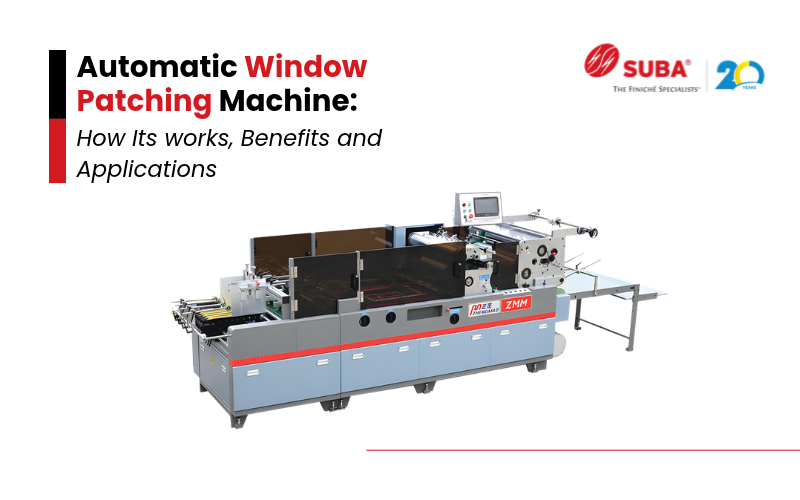
Automatic Window Patching Machine: How It Works, Benefits and Applications
An automatic window patching machine is used to apply transparent film over die-cut carton windows, helping folding carton manufacturers produce window packaging with consistent film placement and controlled gluing. Window patching is commonly used when the packaged product needs to remain visible while still being protected by a paperboard carton.
For manufacturers handling regular window cartons as well as speciality designs, choosing the right machine depends on more than production speed. Carton dimensions, window size and shape, board specification, film thickness, positioning requirements, and the required production output all influence machine selection.
Suba Solutions offers automatic window patching systems, including TC-800H and TC-1050H automatic window patchers, along with V-Cut and hybrid configurations for speciality window applications.
What Is an Automatic Window Patching Machine?
An automatic window patching machine is a carton converting machine that applies transparent film to the window opening of a pre-cut carton blank.
The basic process combines:
Feeding → Gluing → Film Feeding and Cutting → Film Positioning → Delivery
The machine feeds die-cut carton blanks, applies adhesive around the required window area, cuts and positions the transparent film, and delivers the completed patched cartons.
Compared with repetitive manual film application, an automated window patching process can provide more controlled and repeatable film placement while supporting continuous production.
How Does a Window Patching Machine Work?
The exact configuration varies according to the machine and application, but the general process follows several stages.
1. Carton Blank Feeding
Pre-cut carton blanks are placed into the feeding section. The feeding system moves the blanks into the machine at controlled intervals and positions them for the subsequent operations.
Suba’s TC-800H and TC-1050H configurations use servo-controlled intermittent feeding.
2. Adhesive Application
The carton blank moves through the gluing section, where adhesive is applied around the window area according to the carton design.
The machine configuration includes stainless-steel glue rollers and flexible gluing templates to accommodate different production requirements.
3. Film Feeding and Cutting
Transparent film is fed through the film-feeding system and cut according to the required window dimensions.
Servo-controlled film feeding helps control the film movement and supports repeatable film placement.
4. Film Positioning
The cut film is positioned over the adhesive-coated window opening. Automatic positioning and machine adjustments help maintain the required placement during production.
For speciality applications, the V-Cut configuration adds inline punching and is designed for regular and V-cut window applications according to the selected configuration.
5. Delivery
After the film has been applied, the patched cartons move through the delivery section for controlled collection.
This completes the basic window patching process before the cartons proceed to subsequent folding, gluing or packaging operations.
Key Features of Suba’s Automatic Window Patcher
Suba’s TC-800H and TC-1050H window patching machines include features designed around controlled feeding, gluing, film handling and operator adjustment.
| Feature | Production relevance |
|---|---|
| Servo-controlled intermittent feeding | Supports controlled carton blank feeding |
| Adjustable delivery distance | Allows delivery settings to be adjusted according to the job |
| Stainless-steel glue rollers | Supports controlled adhesive application |
| Flexible gluing templates | Helps accommodate different carton requirements |
| Servo-controlled film feeding | Controls film movement during patching |
| HMI adjustment | Provides convenient machine parameter adjustment |
| Automatic positioning | Supports repeatable film placement |
The exact capabilities and working range should always be evaluated against the selected machine configuration and carton requirements.
Regular Window Patching vs V-Cut Window Patching
Not every carton window has the same design. Standard cartons may require conventional window patching, while speciality packaging can require V-Cut or other shaped window configurations.
Regular Window Patching
Standard automatic window patchers are suitable for conventional carton window applications. Suba’s TC-800H and TC-1050H are designed for automatic window patching with servo-controlled feeding, film feeding and positioning functions.
V-Cut Window Patching
V-Cut window patching is intended for speciality window designs. Suba’s V-Cut 650 and V-Cut 1050 configurations use servo-controlled film feeding and inline punching for speciality window applications.
The published V-Cut specification lists ±0.5 mm positioning accuracy and supports regular and V-cut window applications depending on configuration.
Hybrid Window Patching
For manufacturers producing both standard and speciality cartons, hybrid V-Cut configurations can provide a more flexible solution. The appropriate configuration should be selected according to the carton design, window geometry and required production process.
This distinction is important when choosing a window patching machine, because the most suitable configuration depends on the type of cartons being produced rather than simply the machine’s rated speed.
Benefits of an Automatic Window Patching Machine
Consistent Film Positioning
Automated film feeding and positioning can help maintain repeatable placement of transparent film across production runs.
Reduced Repetitive Manual Work
The machine integrates feeding, gluing, film application and delivery, reducing the need for repetitive manual film placement.
Controlled Glue Application
The dedicated gluing system helps apply adhesive to the required window area in a controlled production process.
Better Production Consistency
When carton blanks, adhesive and film are processed through a controlled machine sequence, manufacturers can maintain a more consistent window-patching process.
Support for Different Window Designs
Standard and speciality machine configurations allow manufacturers to select equipment according to their carton window requirements, including V-Cut applications.
Suitable for Commercial Folding Carton Production
For manufacturers producing recurring quantities of window cartons, automated patching can provide a more structured alternative to manual film application.
Actual production performance will depend on carton design, material, film, machine configuration, operating conditions and other job-specific factors.
Applications of Window Patching Machines
Window patching is used when packaging needs to provide product visibility through a transparent film-covered opening.
Food Packaging
Selected food cartons can use transparent windows to provide product visibility while retaining a paperboard carton structure.
Bakery Packaging
Bakery boxes and cartons may incorporate windows so customers can view the packaged product without opening the carton.
Confectionery Packaging
Window cartons can be used for selected confectionery products where presentation and product visibility are important.
Cosmetic Packaging
Cosmetic cartons may use window designs as part of the overall product presentation.
Folding Carton Packaging
Window patching can also be used across other folding carton applications where the carton design incorporates a transparent viewing area.
The suitability of a window patching machine depends on the carton construction, board specification, window geometry, film type and production requirements.
Materials and Film Range
Material compatibility is an important part of selecting a carton window patching machine.
The published specifications for Suba’s TC-800H and TC-1050H range list paper/board up to 4 mm and film thickness of approximately 0.03–0.2 mm.
The V-Cut range has different published specifications, including 0.1–0.25 mm film, with additional film thickness capability using a heater roller on specified configurations.
Because the material and film requirements vary between models, manufacturers should provide their actual board, carton and film specifications before selecting a machine.
What Should You Consider Before Buying a Window Patching Machine?
Selecting a machine based only on speed can result in a mismatch between the equipment and the actual carton application. Before purchasing, consider:
Carton Blank Size
Check the minimum and maximum carton blank dimensions required for your jobs.
Window Size and Shape
Provide the window dimensions and geometry. Standard and speciality window shapes may require different configurations.
Board Material
Consider the board GSM, thickness and, where applicable, flute structure.
Film Type and Thickness
The film material and thickness should fall within the selected machine’s working range.
Required Positioning Accuracy
Determine the level of film-positioning consistency required for your packaging design.
Production Output
Estimate your actual production requirement rather than selecting equipment based only on maximum rated speed.
Gluing Requirements
Consider the adhesive type, glue application area and carton design.
Regular or V-Cut Requirement
If you produce speciality windows, determine whether a V-Cut or hybrid configuration is required.
Future Production Requirements
If your product range may expand to include different window shapes or carton formats, discuss those requirements before finalizing the machine configuration.
Providing these details to the machinery manufacturer can make machine selection more precise and help avoid selecting a configuration that does not match the actual production requirement.
Suba Solutions Window Patching Machines
Suba Solutions offers different window patching configurations for folding carton production.
The TC-800H and TC-1050H are automatic window patching machines designed for regular carton window applications, while the V-Cut 650 and V-Cut 1050 are intended for speciality V-Cut window requirements.
Suba also lists hybrid V-Cut configurations for applications requiring greater flexibility between regular and V-Cut window patching.
The appropriate model should be selected based on carton dimensions, window size and geometry, board and film specifications, required positioning accuracy, production output and the type of window designs being produced.
Frequently Asked Questions
What is an automatic window patching machine?
An automatic window patching machine feeds carton blanks, applies adhesive, positions transparent film over the window opening and delivers the patched cartons.
What is the difference between regular and V-Cut window patching?
Regular window patching is intended for conventional carton windows, while V-Cut configurations are designed for speciality window shapes and V-Cut applications.
Can a window patching machine handle different carton sizes?
Yes, the selected machine can handle different carton sizes within its specified working range and configuration.
What film thickness can a window patching machine handle?
The published specifications vary by model; the TC-800H/TC-1050H range lists approximately 0.03–0.2 mm film, while the V-Cut range lists 0.1–0.25 mm, with additional thickness possible using a heater roller on specified configurations.
How accurate is the V-Cut window patching system?
Suba’s published V-Cut specification states ±0.5 mm positioning accuracy.
What information should I provide when enquiring about a machine?
Share your carton sample or drawing, blank dimensions, window dimensions and shape, board specification, film type and thickness, required output, and whether you need regular or V-Cut patching.
Conclusion
Choosing an automatic window patching machine should begin with the carton rather than the machine. Window size, shape, board specification, film thickness, positioning requirements and production volume all influence the most suitable configuration.
For standard carton windows, an automatic window patcher can provide controlled feeding, gluing and film application. For speciality packaging, V-Cut or hybrid configurations can provide additional flexibility for different window designs.
The right equipment should therefore be selected according to the actual carton samples, materials and production requirements rather than relying on a single specification such as machine speed.
Looking for an Automatic Window Patching Machine?
If you are evaluating a window patching solution for your production line, share your carton sample or drawing, blank size, window dimensions and shape, board GSM/thickness, film specification, required output, and regular or V-Cut requirement with Suba Solutions.
These details can help the team understand your application and identify the appropriate window patching configuration.
About Suba Solutions
Suba Solutions Private Limited provides packaging machinery and related solutions for the folding carton, flexible packaging and corrugated box industries, with equipment covering window patching, die cutting, stripping and blanking, laminating, folding and gluing, carton forming and other packaging processes.